New Year’s Eve day dawned clear and sunny with the promised warm temperature, but the afternoon turned into a snowy winter’s day, ideal for setting a fire and sitting down to a cozy afternoon of reading. The first thing I picked up was the current issue of Birders World.
In it was an article discussing Rhode Island’s harlequin duck hot spot—Sachuest Point National Wildlife Refuge. The forecast for the next day was sunny and in the mid-40s—ideal for a road trip.
After feeding our bluebirds, six of them this morning, we packed a lunch, and loaded Tetley the dog in the back of the car. We took off on what was a 90-minute trip to the refuge. Just before the refuge is a wonderful stretch of Sachuest Beach, where we stopped to give Tetley a good run, as dogs are not allowed in national wildlife refuges (unless one is hunting. How ironic is that!). No sooner had we turned into the parking lot than we saw a harrier. This large marsh hawk, which seems to float over the ground hunting for small birds and mammals, is distinguished by its slender body, long tail, and large white patch at the base of the tail. I always enjoy seeing this raptor cruising over the wetlands looking for its prey.
In the refuge, we decided to take the Flint Rock Trail, which winds through mostly invasive vegetation along a rocky coast. Walking past island rocks we saw our first harlequins—10 or 12 of them bobbing in the surf amongst the rocks, but too far away for a good look.
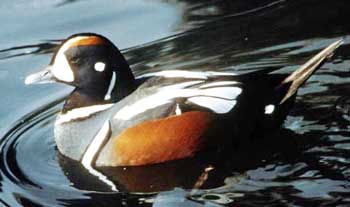
We checked in with Tetley, who was contentedly snoozing in the back of the Subaru, and tried the Sachuest Point Trail loop, which heads south around the point. The trail goes along the bay side of the point above a rocky coast below, giving wonderful views to the mainland where the Gothic tower at St. George’s School church evoked memories of an English landscape. Here we saw a raft of 15 to 20 common goldeneyes, distinguished by their almost-all-white body, black head (green in some lights), and large white crescent at the base of the bills. The female, although not as distinctive, still holds her own with a grayish body and a ruddy, rusty head. There were also five or six common loons cruising along the shoreline this side of the point. We reached the south end of the point, and climbed up onto some rocks, and there before us were 12 to 15 harlequins not 30 feet away, bobbing and diving in the surf and swimming around the rock. The sun was in a perfect position to illuminate the distinctive plumage of the ducks, described by Peter Dunne as “a duck painted in the pattern and style of Pablo Picasso.” The pointed tail on both the male and female is distinctive, as is the single white spot behind the eyes on the all-brown female.
Continuing up the trail on the ocean side we saw more harlequins, common mergansers, and a red-breasted merganser, a beautiful diving duck with black-green head, bold white neck stripe, and distinctive red bill. We wandered back to the parking lot, seeing more harlequins, loons, mergansers, grebes, and scoters along the way.
We marveled at what a wonderful warm New Year’s Eve it was, especially as we were able to walk three or four miles enjoying nature at its best and feeling privileged having seen 40 to 50 of one of the largest wintering populations of harlequins on the East coast—and only 90 minutes from Harvard.