For many on a fixed income, Harvard’s property tax of $11.62 per thousand dollars of assessed value is a daunting sum. For citizens 60 years and over, though, Harvard’s state-sponsored tax work-off program can make a dent in the bill. It lets them work in town jobs in exchange for a modest property tax reduction.
The program is provided for by Chapter 59 Section 5K of state law and was adopted at Annual Town Meeting in 2002. For $7.50 per hour, seniors can work up to 100 hours in a town job and apply the pay directly to their property tax bills.
Tax abatements are capped at $750 per year, with a grand total limit of $9,000 per property. The abatements are helpful to the town, admit town officials, but perhaps inadequate in compensation. Rules for the program are set by the state legislature.
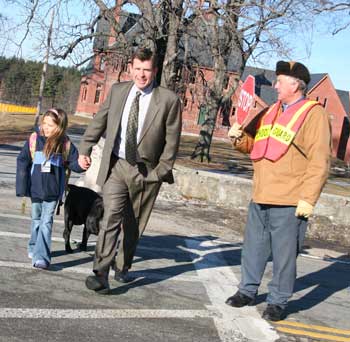
Scarlett O’Brien holds hands with her father, Eric, as they cross the street with the help of crossing guard Bob Hughes, who is helping out at the elementary school as part of the senior tax work-off program. (Photo by Lisa Aciukewicz)
Ginger Quarles, director of the Council on Aging (COA), manages the program. She keeps a list of interested seniors and works with Town Administrator Tim Bragan to solicit jobs from town departments. “We are always on the lookout for more jobs. This year we have more applicants than positions,” said Quarles. Participant Vicki Maxant, a resident since 1993 and a retired librarian, suggested that a change in focus might improve the program. “Harvard’s retired population is well-educated,” she said, and suggested that town officials capitalize on that. “People have experience in grant writing, general writing, computers, finance, and [possess] many other professional skills,” she said.
Quarles says she hopes for municipal departments, including the school, to step forward with additional work. She pointed out that reaction to the program is mixed. “It has been somewhat controversial in the legislature.”
Tax Assessor Angela Marrama, who administers the fiscal side of the program, praised Harvard’s worker-citizens, but acknowledged shortcomings. “Some people feel the program isn’t such a great deal: they’ve been working their whole lives, and now they’re asked to work more, and for minimum wage.” Others, she said, welcome the chance to help, and take the downside in stride. “It’s like killing two birds with one stone. You reduce your taxes, and you take a job that really needs to be done.” She added, “for most of the people who participate, giving back is a way of life.” Marrama is delighted with Chris Ready, who has helped in her office. She also sees a benefit for participants, besides the pay. “When people spend time at Town Hall, they start to personalize the place. It’s not just Town Hall anymore.”
Carlene Phillips is chairwoman of COA’s Board of Directors and served for two years as the program’s coordinator, working with Quarles to match people to jobs. “It’s a good idea, but the program should be expanded by the legislature so people on a fixed income could make a real dent in their taxes. The pay and the cap on the hours are not great,” she said.
Despite its shortcoming, some citizens have willingly stepped forward to take advantage of the program, and several have chosen to speak with the Press about their experience. To a person, they highlight the positive.
Bob Hughes knew when he took the job that the morning and afternoon rush in front of the Harvard Elementary School (HES) was no cakewalk. Impatient commuters, distracted pedestrians, and parents eager for parking spots contributed to a lively, sometimes nerve-wracking scene. Smiling faces were not always part of the picture.
Since Bob has taken his place as a crossing guard, though, people on the crosswalk are all smiles, responding in kind to Hughes’s cheerful greeting. Few will cross the street without benefit of his good will. Even motorists can rate a friendly salute.
Hughes, a retired independent businessman who has lived in Harvard for 44 years, came into his new job through the tax work-off program. “I have no ax to grind about taxes. I’m not a tax complainer,” he emphasized. “I’m there because I’m healthy, I want to help, and I love to be with happy children,” said Hughes, who has five children and 13 grandchildren of his own. He is clearly proud of his family above all else, and is quick to give credit to his wife Lucille. “She did all the work!” he declared, when asked about his life’s partner. She is, he said, a long-time community volunteer as a member of St Theresa’s parish, Harvard Woman’s Club, and other groups.
His affection for youngsters is evident as he ticks off a partial list of the Hughes household’s activities for the week: one grandson’s hockey tournament, another’s charity poker tournament, and visits from two other grandsons and a nephew’s young family. Such events are routine in the busy, family-oriented schedule of Hughes and his wife.
In addition to crosswalk duty, Hughes spends at least an hour each day inside the school, helping the janitors with various tasks. So far, Hughes has nothing but praise for the staff at the elementary school. “I can see how hard everyone works, the front office, the janitors, everyone there. My mother was a school teacher, so I really appreciate the teachers’ effort. I see it here,” he said. He allowed that, in him, “the school is getting a good value. I was a fireman for about 24 years, and I’ve kept up my CPR and first aid certification. I’m good backup.”
Principal Mary Beth Banios agrees, “He’s awesome! He fits in well with the staff, and not only is he incredibly helpful, but his personality is great.” From the front office, Claudia McKenna was also enthusiastic. “He’s like our angel, because he does all those things we can’t get to, but that need really to be done.”
Hughes has always been goal-oriented. His aim in life, he said, was to team with his wife to properly “raise and educate the kids,” to work independently, and to be helpful whenever possible.
On all counts, it seems he was successful. For many years he ran his own wholesale dairy products company, set his own hours, and sent his children to college. He sold his company to West Lynn Creamery in 1992, stayed on to work for several years, and eventually decided to leave the dairy business to work for Boston Coach. He retired last year. “My family wanted me to slow down,” he explained.
Still, Hughes continues his long-standing habit of community service. In addition to helping at the school, he is a member of the local branch of the Rotary Club, a humanitarian service group with a world-wide presence. For nearly 25 years he was a volunteer firefighter in Harvard. Most Tuesdays, he stops at the Hildreth House for lunch and conversation. He also maintains a presence in the business world in his long-standing role as trustee at the North Middlesex Savings Bank.
Today, Hughes contemplates past and future with contentment, recalling with particular fondness the family vacation cottage near Bare Hill pond, now renovated as his primary residence. “It was a nice, short ride to Turner Lane from our year-round place on Madigan Lane,” he noted. Hughes’s affection for his home and community remain strong. “I want to give back to my community for as long as I can,” he said.
Quietly helping where help is needed
Chris Ready, a resident of Harvard since 1971, is another citizen who is motivated by her helpful spirit and love of community. A successful real estate broker, she participates in the tax write-off program in part for its practical benefit, but also to encourage others to partake. “If I am willing to do this, maybe others would do it, too,” she said. “It’s a good program, but I’d like to see more [job] opportunities developed so more people would take advantage of it.” She notes that the property tax on her beloved Still River home has grown seven-fold since 1971, an increase that drives her abiding concern for the town’s elders. “I am very interested in housing for lower and moderate incomes,” she says. Ready firmly believes a healthy town makes room for all income levels and age groups. “I’d like to protect the older population especially.”
As a member the Harvard Housing Partnership and trustee of the Municipal Affordable Housing Trust Fund (MAHT), Ready does what she can to advance her beliefs. The partnership creates a 10-year affordable housing plan and tries to encourage low-income housing, while the newly-created trust will eventually buy or build 100 percent affordable properties for the town. In the past, she has served on various ad hoc committees, the Park and Recreation Commission, and takes a role in the Woman’s and Garden clubs and as a hospice volunteer through her church.
In the tax write-off program, Ready works wherever she is needed: Town Hall, elementary school, and occasionally at the Hildreth House. Her most unusual assignment, however, is at the pond, where she has worked for the past six years from April through June, collecting the $25 fee that out-of-town boaters are supposed to pay for using the pond. “I get there at 5:30 a.m. or earlier and leave between 8 and 9 a.m. The pond is well stocked—the fishermen love it. They show up in little groups, in their warm vests, with coffee and doughnuts, and most don’t mind paying. They realize it’s a good deal.” She derives satisfaction from securing revenue for the town, too, estimating the total early-bird collection at roughly $700 to $800.
Not surprisingly, the woman who is willing to handle pre-dawn duty at the pond is not one to tout her achievements. But others praise her spirit and accomplishments. She is known for a deep knowledge of Fort Devens and the Oxbow National Wildlife Refuge, and according to Selectman Lucy Wallace, “seems to know the name of everyone my age and older!” According to Wallace, Ready is a “sage advisor” who often “goes above and beyond her own self-interest for the community. And she does it without being asked, or expecting thanks.”
Filling a professional need
Vicki Maxant and her husband moved to Harvard from Lexington in 1993, after her retirement from a well-rounded librarian’s career that included time as a college, young adult, and corporate librarian. They were attracted to the bucolic charm and abundant wildlife of the town, which had, she thought, a natural beauty similar to her childhood home in western Massachusetts and the landscape of Ithaca, New York, where she spent her undergraduate years at Cornell University. Aside from the open space and vast opportunity for bird-watching, she said, homes in Harvard were a better value than those in Lexington.
Still, property taxes were high enough to pique her interest in the write-off program, so Maxant sought a job to match her expertise. For the last three years, she has brought her skill to bear in the elementary school library, cataloging batches of new books that arrive at the library between September and June. “This is a professional skill that I have, and I’m glad to fill the school library’s need,” she explained, noting that librarian Peggy Harvey has her hands full meeting the needs of elementary-school-age pupils. Maxant enjoys the work, especially since she has not worked in a children’s library before now.
Maxant is so glad to help, in fact, that she may well volunteer for time beyond the 100 hours. “I wouldn’t be working if I didn’t have the expertise, or care about the work,” she said. The wage is low, and “I wish they’d push the hours up, but money is not the prime motivation. I was looking to help out.”
Maxant shares her love of books through the Harvard Public Library, too. She volunteers for the Friends of the Harvard Public Library, which supports the town library through fundraising (think annual book sale), and providing museum passes and children’s programs. Her pet project is bringing library books to shut-ins. Library trustee Jeff Harris, she said, came up with the idea, and she immediately began checking out and returning books for people who couldn’t get to the library anymore. “It was a good fit for me,” she said. “It maintains my relationship to books, and to the people who read them.”
For more information about the tax write-off program, contact COA Director Ginger Quarles at (978) 456-4120 or coa@harvard.ma.us.