Barred owls make the winter night ring
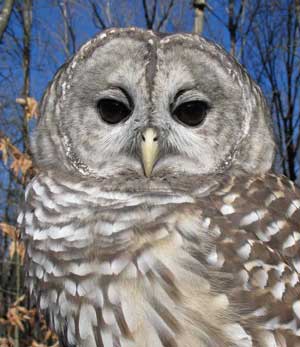
With its soulful brown eyes and gentle demeanor, the barred owl gives no hint of its wilder, vocal side. This owl is aptly named for its horizontally barred throat and vertically striped breast feathers. (Photos by Mary Holland)
You wake in the middle of the night to maniacal laughter outside your window. Raucous caterwauling, one voice on top of the other, breaks the silence of the woods. After listening to this jumble of cackles, hoots, caws, and gurgles for a minute or two, you know it can be none other than a pair of barred owls (Strix varia) in the passionate throes of courtship.
Barred owls can be heard every month of the year in Harvard, but are most vocal during the months of February and March when they engage in courtship behavior prior to mating and laying eggs. As part of this ritual, the male and female often perform a dueling duet asking each other, “Who cooks for you? Who cooks for you-all?” It is relatively easy to distinguish the lower-pitched male from the higher-pitched female when they are calling back and forth in this manner. The barred owl has a broad repertoire of calls in addition to the caterwauling and “Who cooks for you?” calls. Single hoots as well as series of ascending hoots are also given by both males and females. There is a resurgence of vocalizations in late summer and fall, but it pales in comparison to the conversations that take place this time of year.
If it weren’t for these calls, it would be very easy to overlook the presence of barred owls in our mature woods, for their nocturnal habits and sound-muffling feathers make them very hard to detect. The only audible hint of their presence, other than their calls, is the loud cacophony that occurs when other birds such as ravens, crows, jays, and songbirds gather to harass or “mob” the owl while it perches on a limb. Making a terrible racket and repeatedly diving at the owl, these birds recognize that although birds of prey may be a threat to an individual smaller bird, there is safety in numbers.
At this time of year, if the barred owl isn’t courting, it is usually hunting for prey. The peak of its nocturnal hunting activity occurs just after sunset. Using its acute vision and hearing, the barred owl locates and consumes small mammals such as mice, voles, squirrels, and rabbits, which comprise up to 75 percent of its diet. Birds up to the size of a grouse, amphibians, reptiles, fish, and invertebrates make up the rest of its diet, depending on the season. Predators such as owls are known to occasionally eat other smaller predators. As improbable as it may seem, a dead barred owl was found in New England with the remains of a long-eared owl inside its stomach; inside the long-eared owl’s stomach were the remains of a screech owl.

By dissecting an owl’s pellet you can determine exactly what it has eaten. These bones were all from one pellet cast by a barred owl in the wild. It had recently dined on white-footed mice, a star-nosed mole and an eastern chipmunk.
Barred owls usually hunt by surveying the forest floor for signs of life while perched on a branch. When prey is spotted, the owl drops down and captures it on the ground with its sharp talons, or nails. Barred owls have also been known to perch on a limb over open water and dive down to capture fish. Other hunting techniques that have been observed include wading into shallow water to capture crayfish and running on the ground chasing amphibians.
Regardless of where or how they find food, barred owls swallow small prey whole, head first. Between eight and twelve hours after a meal an owl regurgitates the indigestible parts of the prey it has eaten in the form of an odorless, compact pellet. The larger the bird, the larger the pellet: barred owl pellets are approximately three inches in length and one inch in diameter. Within the pellet, fur is packed around most of the sharp objects such as bones, nails and teeth so as to facilitate their passage through the owl’s esophagus as the pellet is being coughed up. By examining a pellet’s contents you can determine the nature of the owl’s diet, right down to the species of rodent it ate.
If you’re lucky, you may catch a glimpse of a barred owl gliding gracefully among the branches of your woodland trees. However, these owls are definitely heard more often than they are seen. Being quite territorial and thought to mate for life (which can be as long as 18 years in the wild), barred owls tend to remain in the same area for a long time. Step outside in the middle of a February night or sleep with your windows open—and know that what sounds like a bunch of raucous monkeys or someone inquiring about your culinary services may be just two feathered friends celebrating Valentine’s Day in their own unique fashion.
Mary Holland can be contacted at mholland@vermontel.net.