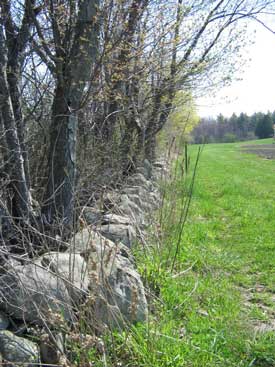
The Maxant land in Still River is under a conservation restriction. (Phote courtesy of the Harvard Conservation Trust)
Conservation restrictions have always offered strong income and estate tax benefits to landowners, but last year Congress passed legislation that dramatically increased the income tax benefits. These new benefits expire December 31, 2007, so the window of opportunity is narrow.
These tax changes have helped to counteract the effects of exploding land values over recent decades, which have made land preservation increasingly difficult. Cash-strapped towns and land trusts have been less able to purchase land outright to preserve it for the future.
Enter the conservation restriction, which prohibits further development on the land, but often allows a wide range of other activities, such as farming, forestry, or equestrian activities.
Essentially, the landowner decides what uses will be acceptable on the land (trails, agriculture, recreation, etc.) and what, if any, development can occur there. That information is laid out in a written document in which a town or land trust becomes the “owner” of those rights and is obligated to enforce the terms of the agreement against all future owners of the land. Thus, if a conservation restriction allows only for agricultural buildings but a future owner tries to build residences, the town or land trust is obligated to stop to the building.
Since a gift of a conservation restriction entitles the landowner to a charitable deduction, a qualified appraisal is necessary to calculate the value of the gift and the state must approve the arrangement. Ultimately, the conservation restriction is recorded at the Registry of Deeds so that all future purchasers of the land have notice of the restrictions before buying.
The two principal benefits are, first, an increase in the cap on the charitable deduction for a gift of a conservation restriction to 50 percent of the donor’s adjusted gross income—from 30 percent—and, second, the “carry forward” period for taking deductions in future years is now a whopping 15 years, up from five years.
To illustrate the actual tax savings, assume that the landowner’s adjusted gross income is $120,000 per year and the gift of the conservation easement is worth $450,000. The following chart shows the charitable deductions the landowner may take:
The new rules would have generated approximately $123,000 in actual tax savings over eight years compared to $67,000 of savings over six years under the old rules. This assumes that federal income tax rates don’t change during the period (although if the rates increase, the savings would increase, too). It is also important to note that these deductions do not make the landowner any more likely to be subject to the alternative minimum tax.
The landowner is still free to sell the land on the open market or to bequeath it to family members, but all future owners must adhere to the conditions laid out in the conservation restriction. Thus a developer would be unlikely to buy the land, but someone who is not interested in developing (for example, using the land as a farm or horse property) would probably not be deterred from buying. To a certain extent, the landowner can craft the conservation restriction terms to maximize resale value of the property. Conservation restrictions can offer attractive estate tax savings, and preservation-minded heirs can even put them in place after the landowner’s death.
Only conservation restrictions that are approved by December 31, 2007, will qualify for the enhanced benefits. As the process for completing a conservation restriction typically takes many months, anyone interested in taking advantage of this opportunity should begin the process as soon as possible. More information on conservation restrictions is available at harvardtrust.org.
Dennis Delaney lives on Bolton Road and is a lawyer and professional trustee at the Boston firm of Hemenway & Barnes and a volunteer trustee of the Harvard Conservation Trust.