Director: George Miller
Starring: Elijah Wood, Robin Williams, Nicole Kidman, Hugh Jackman

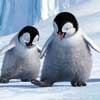
A scene from Happy Feet. (Courtesy photo)
When faced with the four-week-old penguin movie or the brand-new adaptation of Charlotte’s Web, my son chose the penguin movie. And I was grateful he did. Happy Feet is a surprisingly rousing and unusual film. That it has turned into such a big hit is all the more surprising. Director George Miller, writers Warren Coleman and John Collee, and computer graphics company Animal Logic have walked so many tricky lines in pulling off this tale, it’s a marvel the movie works at all. There’s the trick of setting the majority of the movie in the austere landscape of the Antarctic. Then there’s the challenge of differentiating between the thousands of nearly identical penguin characters. But Happy Feet doesn’t stop there. It employs a Moulin Rouge-like amalgam of songs to represent the mating habits of the penguins (walking a particularly troublesome “reproduction” line). Then there’s an additional message about human intrusion, not to mention a religion issue. This is certainly the most ambitious narrative yet for a mainstream computer graphics film. Happy Feet is a little too long and takes on too many major themes, but as a combination of technical splendor and complex storytelling, it’s a very rewarding movie.
The setting is the same world that was chronicled in March of the Penguins. In fact, it essentially relies on viewers having seen last year’s popular documentary to understand the set-up: Mom and Dad (Nicole Kidman and Hugh Jackman) meet, Dad protects egg while Mom spends harsh winter searching for food. From there it deviates from nature very creatively. Every penguin must find its own song (which allows the filmmakers to cram in all sorts of current and former hit songs). Young Mumbles Happy Feet (Elijah Wood) has no singing voice, but he can dance like Savion Glover (literally—Glover supplied the choreography and motion-capture). Even though Mom and pretty Gloria (Brittany Murphy) accept Mumbles for who he is, the rest of the penguins—including the elders and Mumbles’ own father, consider him a weirdo. Mumbles heads off on his own, eventually meeting a quintet of smaller penguins from a different tribe. These guys think Mumbles’ feet are amazing, and give him the confidence to go back and claim his place.
But there’s a bigger problem hanging over the Antarctic—strange “aliens” who are depleting all the creatures of their habitats and food supplies. Mumbles determines that the one way to prove himself to his tribe is to stop those who are taking their fish.
This is where Happy Feet graduates from beautifully executed, relatively insignificant entertainment to something more daring. It also enters its trickiest territory yet—how do we entertain and thrill the audience while painting an accurate picture of reality? Especially when that reality has us squarely pegged as the villains. Happy Feet reaches rare levels of exuberance, but also goes to some pretty dark places from which there’s no realistic escape. The final bit of fantasy it attempts is somewhat grounded in reality, but also somewhat uncomfortable.
Director George Miller and company must have given Warner Brothers the vapors with this expensive, non-formulaic venture. On top of that, they relied on a computer graphics company that had never made a full-length animated film before. Even if Happy Feet were another manufactured kid flick, the visual work would be worth applauding. From stunning snowy vistas to brutal windstorms, from penguins flitting through the water to elephant seals slogging across the ice, Animal Logic has done a tremendous job.
One final note: this is most definitely a PG movie. There are truly scary moments and lots of innuendo (mostly in the form of song lyrics). And have I mentioned the dark parts? I’d stick to ages 7 and up. But given the choice of “family entertainment” available this season, Happy Feet may be your best bet.
Alex Manugian lives in Sherman Oaks, California and works for the Cartoon Network. He grew up in Groton and has reviewed movies for Harvard residents for many years.