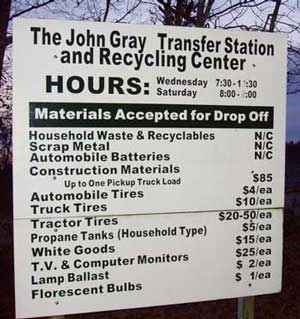
Sign at the transfer station spells out pricing. (Photo by Laura Andrews)
The Department of Public Works rescinded its new scrap-metal policy this week in response to residents’ complaints that the scrap-metal pile at the transfer station was a needed resource and part of the town’s culture.
“I didn’t realize how attached people were,” DPW Director Rich Nota said, although he said he does have a sense for community character from his last job, in Weston.
Nota said in an interview Monday that when he started his job in April, he found outdated pricing on recycled materials. Prices, particularly for scrap metal, had increased and Harvard was not taking advantage of the market, he said. At $50 per ton, Nota calculated that the metal pile was worth around $12,000 per year, given that residents drop off approximately five tons per week. The removed pile that raised resident objections weighed 20 tons and brought in revenue of $1,000, Nota said.
Nota’s examples of people who use the scrap metal included a father and son who find materials to use in scientific projects, people who disassemble appliances for resalable parts, and others who “cherry pick items with value,” he said. Nota said that he still would like to find ways to increase revenue from recycling, so will try to come up with a way residents can comb through the scrap for awhile, and then DPW can sell what remains.
No change at take it or leave it
No changes are planned for the goods-swap area known as Take It or Leave It (TIOLI), Nota said. “That area is sacrosanct,” he said. He added that he wishes people would be more careful about what they drop off, since broken appliances, water-damaged goods and other non-useable leavings have to be thrown out by the highway department at the end of the day.
The orange cones around TIOLI last Saturday apparently resulted from problems with traffic that morning, Nota said, because no formal change had been made. A transfer worker told this reporter Saturday that parked cars blocked the traffic dropping off trash in the compactors and children were running around unsupervised, creating a safety and efficiency problem.
Changes could be made to TIOLI, Nota said, such as finding a covered area—even a large container—to be able to protect goods from rain or snow. He used a container in Weston he said. “It did tend to bring a crowd, waiting around for things to be dropped off,” he said, and an occasional argument.
Nota was clear that even though he is trying to find money for the town, “It’s input before action. Before I make any more changes, I’ll make sure it’s a more public process.